



www.clairecaterer.com
about Claire M. Caterer books by Claire M. Caterer blog with Claire M. Caterer Press for Claire M. Caterer Fun Extras with Claire M. Caterer Contact Claire M. Caterer Other Writing by Claire M. Caterer
NOTE: I don't post to this blog super-duper often anymore, because I'm busy writing, well, books. (Read more about that here.) For more up-to-date, day-to-day ramblings, visit my Facebook page.

Thursday, February 2, 2012

What I Learned About Conferencing: Part I

What a fantastic weekend! Okay, I know, it's Thursday, I should be over the weekend by now and ready to head into my next one, but it has taken me fully this long to assimilate everything I learned at the Society of Children's Book Writers & Illustrators (SCBWI) international conference this past weekend. And while I may share the tiniest tidbit of wisdom (the material is under copyright and SCBWI is understandably stern about, say, blogging someone's entire speech), I can certainly share these general highlights of what I learned about conferencing in general. (Conferencing: a word? Webby: Nuh-uh. It's a noun, not a verb, dingy.)

(1) Dress Code.
Here's the great thing about writers, especially those who write for kids: They sit behind a desk all day (or as often as they can). They may own fluffy slippers with rabbit ears on them. Flannel pajamas illustrated in different coffee logos. In other words, no one goes to a writer's conference dressed in Armani. "Business casual" might mean a lot of things to different people, but for me, it was:
  • black slacks (mine had a little stretch to them, thanks)
  • colorful shirt/blouse
  • basic black blazer, for layering (some rooms are hot, others cold)
  • comfortable black shoes
I was neither overdressed nor underdressed, and most important, I was comfortable. The first day I sat in a room from 8:00 a.m. till 5:00 p.m. We had one lunch break and one coffee break. So comfort is key.

I opted for nice jeans with this same kind of ensemble on Sunday morning. I figured Sunday was more relaxed, I was getting on a plane later, and anyway, the email they'd sent me said jeans were fine. Again, that worked out perfectly. I could've gotten away with nice jeans all three days, but since we went out to a bar and then one night there was a cocktail party, I was glad to have the black slacks.

(2) The Proper Use of a Laptop.
I borrowed a notebook computer from my mom to take on the trip. I was very glad that I hadn't dragged along my home laptop, which is too big and heavy for the purpose. I did not use the notebook to take notes during conference sessions. Our packet info warned us that tapping on iPads or notebooks could be distracting to others, and a couple of people I talked to did complain about that. I kept mine in the hotel room safe and used it to transcribe notes at the end of the day. Because SCBWI provided us with free Wi-Fi during our stay, I could easily check email too.

(3) How to Pace Myself.
The information we received was so plentiful, so overwhelming, that our heads were reeling, especially after the Friday Writers' Marketing Intensive. I learned that if I needed to take a quick bathroom break, people were okay with that, as long as I was quiet and didn't interrupt the proceedings. I decided I didn't need to go to the afternoon all-conference speech on Saturday before the second round of breakout sessions; it wasn't a topic I was interested in. So I took a long lunch and went down to the Union Square farmers' market.
Did it feel a little like playing hooky? Yeah, kind of, but it was my weekend, to do with as I needed. And I needed to recharge a little, step out in the sun (the weather was gorgeous), and just be in New York. The farmer's market was the perfect diversion. I was raring to go for the next round of sessions, drinks with my agent, and the cocktail gala that followed.


Hey, But What About Networking and Stuff?
Yeah, I learned some of that too. More tomorrow. Your eyes are getting tired.

Wednesday, January 25, 2012

She Knows How I Feel

I'm heading off to New York City tomorrow to attend my very first Society of Children's Book Writers & Illustrators (SCBWI--yeah--a mouthful of an acronym) conference. So how's it feel? Let's let the always funny Debbie Ridpath Ohi tell it like it is:


Thanks, Inkyelbows. You made me laugh today.

For more of Debbie's cartoons and other great stuff, go to her site.

Tuesday, January 24, 2012

Review: INTO THE BEAUTIFUL NORTH by Luis Alberto Urrea


Contemporary Fiction
Back Bay Books, 2009
338 pages  $14.99

I’m always astounded by how many great writers exist whose work I’ve never read and never heard of. Luis Alberto Urrea was one of them until I ran across Into the Beautiful North on some list or other and requested it as a Christmas gift—in 2010. I know, I know, I’m behind on my reading. Shut up. But this book was worth the wait.

First of all, I admire with a little teeth-grinding jealousy someone who can write such lyrical prose in English and yes, in Spanish, too! Both this book and Urrea’s The Hummingbird’s Daughter  (now also on my reading list) are available in both languages. Because he’s just that good. The sentences flow, the descriptions blossom into pictures right before your eyes, and besides all that, the story is eminently readable, suspenseful, exciting.

It begins in a small, dusty, forgotten Mexican town called Tres Camarones. Most of the able-bodied male population has fled north, leaving the mostly female community vulnerable to drug bandits and negative population growth. Nayeli, a plucky 19-year-old, decides after seeing Yul Brynner kick butt in The Magnificent Seven that there’s only one way to save this dying town: Go to the USA and bring back seven magnificent Mexican men to drive out the banditos and spawn a new generation. So she packs up and braves a journey across the border with her homegirls and their gay male buddy to do just that.

A great road-trip novel like this one wouldn’t be complete without wacky characters and dangerous experiences, but the book is anything but formulaic. It’s funny, original, and peopled with folks you wish you could know outside the pages. Those of us who live in Los Yunaites and take it for granted get to see it through the eyes of outsiders—the good and the bad. Are Nayeli and her fellow “wetbacks” treated well? Sometimes. Is the Beautiful North all it’s cracked up to be? Again, sometimes. This is one of those books that you alternately savor and race through, wishing the story went on and on after the last page. And, like all good stories, it does. We just don’t get to read about it.

Friday, January 20, 2012

Congrats, Johanna!

A great big CONGRATULATIONS  to Johanna Harness, the recipient of Beyond the Margins' first annual Above and Beyond Award! I have corresponded with Johanna on Twitter, and she is always kind, responsive, and supportive. Follow her yourself here, and visit her #amwriting site here. You'll be glad you did.

Tuesday, January 3, 2012

Review: MARY POPPINS by P.L. Travers

Mary Poppins
Middle-grade fantasy
Harcourt, 2006 (originally published 1934)
224 pages  $12.95
My rating: 5 of 5 stars


Why am I so wild about Mary that I award her the coveted five out of five stars? It may be childhood sentimentality, I admit. My mother used to read Mary Poppins as well as Mary Poppins Comes Back aloud to us in the car on long vacations. Nothing could hold me as mesmerized. I so wanted a nanny who could serve tea on the ceiling or rescue me from the nasty characters inside a Royal Doulton bowl. I was devastated every time Mary left, even knowing she would come back. I loved her because she wasn't sugary sweet (the lovely Julie Andrews notwithstanding); magic was part of who she was and she saw no nonsense in it. So what if extraordinary things happened whenever Mary was around? Children still had to go to bed on time and drink their cod liver oil (though when Mary administered it, it was somehow delicious).

I envisioned that one day I would live on Cherry Tree Lane, where the cherry trees danced down the center of the street with houses running down one side and the park on the other. This book was probably the beginning of my deep and abiding love of all things English.

Friday, December 2, 2011

I Ain't Gonna Love You No Mo

I know this interview was awhile ago, and I posted it on a previous blog, but it's still funny. The Rock Bottom Remainders is a rock(?) band made up of several writers, among them Dave Barry, Stephen King, and Amy Tan. Below, Steve Martin calls these writers to task for their grammar.

Saturday, October 15, 2011

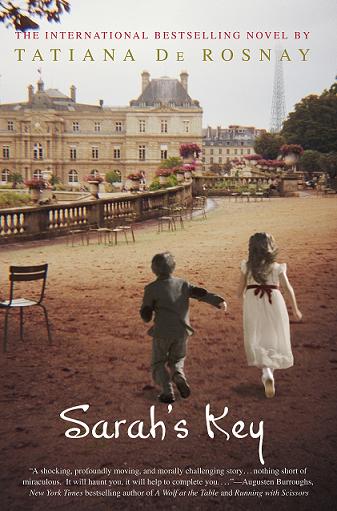
Book Review: SARAH'S KEY by Tatiana de Rosnay

Contemporary/Historical Fiction
St. Martin’s Press, 2007
320 pages  $13.95

On the nights of July 16 and 17, 1942, French police rounded up over 12,000 Jewish citizens and brought them to the Vélodrome d’Hiver, an indoor stadium not far from the Eiffel Tower in Paris. After a few days, these Parisians—over four thousand of them children under the age of 13—were deported to holding camps outside the city. From there, parents and children were separated, shipped to Auschwitz, and killed in the gas chambers.

This incident is known as La Grande Rafle (“The Great Raid”) du Vél d’Hiv. It is one of several wartime incidents that brought such shame to Frenchmen that it was not openly acknowledged for 50 years. Finally, President Jacques Chirac admitted to the responsibility of the Vichy government in a commemorative speech in 1995.*

These events form the backdrop of Tatiana de Rosnay’s startling novel Sarah's Key. Ten-year-old Sarah is arrested by French police on July 16; but before she is taken, she hides her younger brother in a secret cupboard, promising she will come back for him. Her story is juxtaposed with that of Julia, a modern-day American journalist investigating the Vél d’Hiv atrocities as her marriage to a Parisian begins to crumble.

With two such riveting stories—Sarah’s race to save her brother and Julia’s obsession to uncover her story—it is hard to find fault. This is a book that can be swallowed nearly whole. De Rosnay creates engaging characters, even if they seem a bit stereotypical. (The charming yet philandering French husband and the grouchy but good-hearted managing editor come to mind.) Complex, guilt-wracked Edouard, who was a boy in 1942 Paris, is endearing, and Sarah’s grit comes across as genuine, not some Anne Frank-wannabe. The novel’s problems lie mostly in its prose; de Rosnay has a better gift for plot than for the turn of a phrase. The Holocaust is such well-trod ground that, shockingly, we all know what to expect, even if the events are all new to the characters themselves. It requires a deft writer to avoid stereotypes and melodrama, and de Rosnay sometimes comes up short.

On the other hand, the Vél d’Hiv story is largely unknown, which makes this novel relevant even now. The author gives the facts as they happened, inserting her characters into the action, and our hearts race along with theirs. It is a story to cry over, an unbelievable chapter in our collective humanity’s history. Strange that it has become fodder for fiction, for entertainment. But we come to the end of Sarah’s long journey not exactly entertained, but brought up short, astounded and horrified once again. Why dredge up these darkest moments in our past? It is because the darkness lingers still among us, in Bosnia, in Rwanda, in Darfur. We cannot afford to forget.

*With thanks to JewishGen.org for historical information on the incidents at Vélodrome d’Hiver.