Are you a Grammar Hammer? Thanks to Playbuzz for this Fun Friday!

 |
|
|
|
|
|
|
|
 |
|
||||||
 |
 |
 |
 |
 |
 |
 |
|
Showing posts with label grammar and usage. Show all posts
Showing posts with label grammar and usage. Show all posts
Friday, August 1, 2014

Friday, July 25, 2014
Fun Friday: Word Crimes
It may have come to your attention that I rag on other people's bad grammar. It's the curse of the copy editor and the writer, and sadly, I'm both, so ... guilty.
But at least Weird Al Yankovic is here to justify my behavior. Word Crimes: Who will we arrest next?
But at least Weird Al Yankovic is here to justify my behavior. Word Crimes: Who will we arrest next?
Friday, May 9, 2014
Fun Friday: Commas and Pants, Both Needed
In case you all haven't noticed, Debbie Ridpath Ohi is hilarious and wickedly talented. The illustrator of I'm Bored (written by Michael Ian Black; Simon & Schuster Books for Young Readers, 2012) and the cool new Judy Blume covers, Ohi also maintains a fantastic website here. Here, reprinted with her permission, is one of her classic strips, Will Write for Chocolate.

Used with permission from Debbie Ridpath Ohi at Inkygirl.com under the provisions outlined here.
Used with permission from Debbie Ridpath Ohi at Inkygirl.com under the provisions outlined here.
Friday, April 11, 2014
Fun Friday: Who Gives a #^(! About an Oxford Comma?
I'm a fan of the Oxford comma, people, and not just because it's named after the Oxford University Press, which makes it sound like a supersmart thing. It's come from years of editing using the style book most favored by American publishers, The Chicago Manual of Style. But its use is--gasp--optional. Here's today's informative video on the topic:
And here's today's irreverent take on the topic. (Caution: an R-rated word is featured. You've been warned.)
And here's today's irreverent take on the topic. (Caution: an R-rated word is featured. You've been warned.)
Tuesday, December 10, 2013
Pet Peeve: Desert vs Dessert
Blogfrogs, let's make this short and sweet, because I have Christmas shopping to do, and no doubt you have something else you should be doing too.
So: Speaking of sweet, dessert is that lovely course that comes at the end of the meal. Because it's so sweet, it deserves two s's. (See how I threw in that pnemonic? Aren't I just the bee's knees?)
But desert is so arid and dry, it's soaked up one of its s's and is left with only one. Also, it's a verb, as in "to abandon." Because, see, it abandoned one of its s's, and ...
Well, you get the picture.
This lovely bûche de Noël is a dessert:

This superdry place is a desert:

Got it? Swell. Back to the mall, after which I expect you'll have a nice cup of eggog generously laced with something nice waiting for me when I return.
images: Top: my very own photo of my very own bûche de Noël, which I make every Christmas.
bottom: Desert near Marsa Mubarak, Egypt. Courtesy of Wikimedia Commons. Photo by Marc Ryckaert (MJJR). This file is licensed under the Creative Commons Attribution 3.0 Unported license.
So: Speaking of sweet, dessert is that lovely course that comes at the end of the meal. Because it's so sweet, it deserves two s's. (See how I threw in that pnemonic? Aren't I just the bee's knees?)
But desert is so arid and dry, it's soaked up one of its s's and is left with only one. Also, it's a verb, as in "to abandon." Because, see, it abandoned one of its s's, and ...
Well, you get the picture.
This lovely bûche de Noël is a dessert:

This superdry place is a desert:

Got it? Swell. Back to the mall, after which I expect you'll have a nice cup of eggog generously laced with something nice waiting for me when I return.
images: Top: my very own photo of my very own bûche de Noël, which I make every Christmas.
bottom: Desert near Marsa Mubarak, Egypt. Courtesy of Wikimedia Commons. Photo by Marc Ryckaert (MJJR). This file is licensed under the Creative Commons Attribution 3.0 Unported license.
Tuesday, November 12, 2013
Pet Peeve: More Unique
Friends, writers, random people who happened on this post, I know that we Americans love our superlatives. It's why we're gaga about exclamation points. Nothing is just enjoyable; it has to be

or we can't say we've gotten any pleasure out of it. I'd love to launch what might be called a moderation campaign, but my reasonably pitched voice would be lost in a sea of grinning emoticons and boldfaced adjectives.
And yet.
We do have to keep in mind what certain words mean, which brings me to this month's peeve (finally, they sigh): unique. Here's Webby's definition:
Think about another word--best--that can have no comparative. Or fastest. Only one horse in a race is the fastest. No one says:

or we can't say we've gotten any pleasure out of it. I'd love to launch what might be called a moderation campaign, but my reasonably pitched voice would be lost in a sea of grinning emoticons and boldfaced adjectives.
And yet.
We do have to keep in mind what certain words mean, which brings me to this month's peeve (finally, they sigh): unique. Here's Webby's definition:
being without a like or equal : single in kind or excellence : UNEQUALED : SOLESo if you think something is particularly unusual, distinctive, what have you, you might call it unique, but is that in fact what you mean? Unique means one of a kind, so something or someone can hardly be more unique than someone or something else. Unique is thus a word than can have no comparitive. You could say:
That's the strangest-looking dog I've ever seen.But you couldn't say:
That's the most unique dog I've ever seen.That implies that you've seen unique dogs before, but not one quite that unique.
Think about another word--best--that can have no comparative. Or fastest. Only one horse in a race is the fastest. No one says:
The palomino was pretty fastest, but the chestnut was definitely more fastest than he.So do let's stop calling an unusual thing or person very unique or the most unique, shall we? Try using exceptional, remarkable, unusual, or some other adjective. That will help add a few more years to my weak heart.
Wednesday, October 23, 2013
Just ... yeah.

In fond memory of my dad, Ken Caterer, who made sure I understood the differences here. Thanks to Grammar Police for sharing.
Tuesday, October 8, 2013
Pet Peeve: Between You and I

It's just a rule. And when you violate it, you're wrong.
Sorry to be blunt. Here's the scoop:
It was drilled into our preteen heads from Day One (or Day One of grade school) that when speaking of oneself and another person, one must use I, not me, as in:
Jeeves and I went on a fishing trip.
Jeeves and I had tea at four o'clock. (Or rather, I had tea, which Jeeves served.)
and so on. Only the laughably ungrammatical among us would say:
Jeeves and me hopped a train to Aunt Dahlia's house.
But here's the catch--the footnote to the main memo, you might say--that so many of us have overlooked. This rule only applies when the I in question is the subject of the sentence. You'd never say:
Me hopped a train to Aunt Dahlia's house.
So, no matter how many folks hop that train, I is always I, and never me:
Barmy, Bingo, Stinker, Jeeves, and I hopped a train to Aunt Dahlia's house.
But again I say: This rule only applies when the I in question is the subject of the sentence. Would you ever say:
Aunt Dahlia has been spreading vicious rumors about I.
Of course not. Nor would you say:
Aunt Dahlia had a particularly onerous problem for I to solve.
Instead, you'd say:
Aunt Dahlia has been spreading vicious rumors about me.That being understood, it doesn't matter how many people Auntie D has been spreading rumors about, nor how many heads she needs to solve her problem. Me is always me.
Aunt Dahlia had a particularly onerous problem for me to solve.
Aunt Dahlia had a particularly onerous problem for Jeeves and me to solve.
Aunt Dahlia has been spreading vicious rumors about Jeeves, Barmy, Bingo, Stinker, and me.
Aha! you say. But it's still between you and I, isn't it?
No, it isn't. Between, gentle readers, is a preposition, like about, upon, of, beneath, etc. Prepositions take object pronouns. If you don't know what those are, don't fret. Take my word for it: Me is one of them. (Here's a list of common English prepositions, if you're interested.)
"That task is beneath me, Aunt Dahlia," said Bertie. (Beneath I? Never!)
And so:
"That task is beneath Jeeves and me, Aunt Dahlia," said Bertie.And yes, now we come to it:
"Dash it, Jeeves, but between you and me, I think Aunt Dahlia has too much time on her hands," said Bertie.And so it is with all prepositional phrases:
- between you and me
- for you and me
- about you and me
- of you and me
Here's the takeaway, and a foolproof rule: When wondering if you should use I or me, ask yourself what you would use if the sentence didn't involve a lot of other people, and go with that.
Here's a picture of Jeeves and me out on our pleasure cruise.I feel so much better having that peeve off my chest. Time to ring Jeeves to bring something bracing, I should think.
Here's a picture of me out on my pleasure cruise.
"She wasn't talking about you and me, sir," said Jeeves.
"She wasn't talking about me, sir," said Jeeves.
That isn't something you and I would do, is it?
That isn't something I would do, is it?
Friday, August 2, 2013
Hyphen Redux
I just found this handy infographic poster for those who are still scratching their heads on the use of the hyphen. It comes courtesy of Grammar.net, which specifically invites folks to embed it on their own sites. So, yeah. I'm not stealing it.
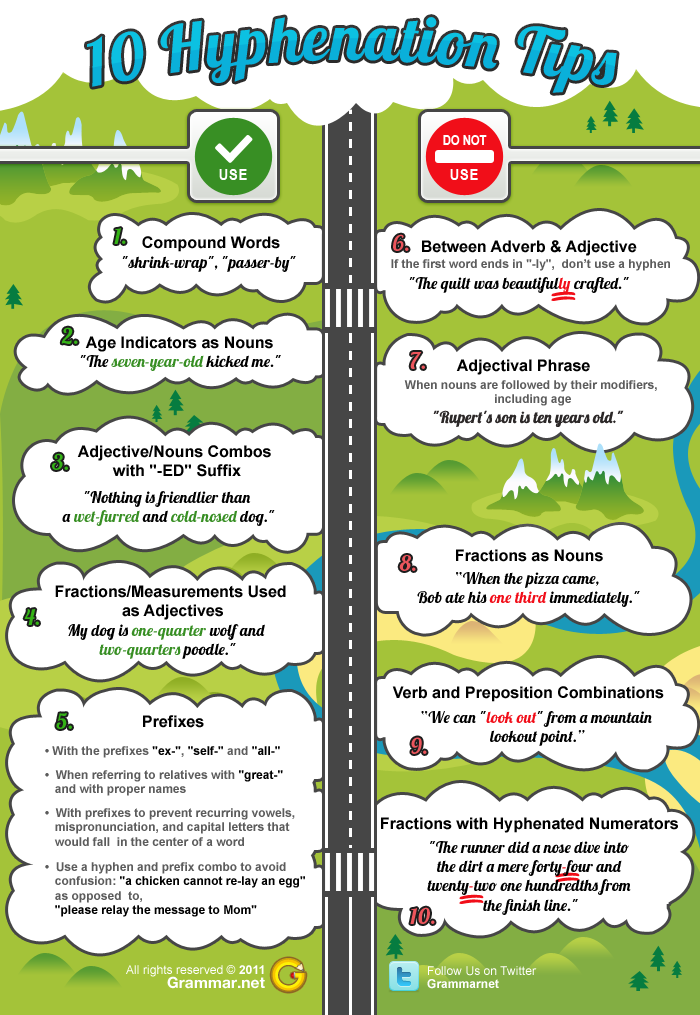
[Infographic provided by Grammar.net]
[Infographic provided by Grammar.net]
Tuesday, July 9, 2013
Pet Peeve: Adverbs and Hyphens

It's come to my peevish attention that hyphens are fast becoming the new scare quotes. In other words, people are suddenly confused about where hyphens are needed, and in a panic, they're inserting them all over the place. But here's a place where you don't need them:
between
an -ly adverb and the word it modifies
First of
all, a refresher course: An adverb is a word that modifies (i.e., describes) a
verb or adjective. Adverbs often (but NOT always) end in -ly:
perfectly
nastily
swimmingly
knowingly
Now, no
one seems to want to stick in a hyphen when these adverbs modify verbs, as in:
Dumbledore winked slyly.Hermione calmly stowed her wand and climbed on Buckbeak's back.Filch smiled nastily.
But for
some reason, when the adverbs modify adjectives, hyphens are applied
willy-nilly. There's no need. So:
The Triwizard Tournament includes three extremely dangerous tasks. (NOT: extremely-dangerous)Ron had a perfectly good reason for avoiding the Forbidden Forest. (NOT: perfectly-good)"Thanks for helping us fight those Death Eaters," said Harry to Neville. "That's awfully decent of you." (NOT: awfully-decent)"A poorly brewed potion will earn you a failing grade," Snape said. (NOT: poorly-brewed)
The
confusion may have arisen because according to the venerable Chicago Manual of Style, adverbs that DON'T end in -ly (and thus,
may be mistaken for some other kind of word) do take a hyphen:
"I must admit, Potter, that's a well-cast spell," said Professor Flitwick.
Because
this isn't a grammar blog (anymore), I won't go into all the ins and outs of adverbs and
adjectives, but you may certainly surf on over to The Grammar Girl for more info. It won't
bother me one bit.
Back to
your studies now. You never know when a pop quiz may be in the offing.
Hyphen update: More, and perhaps clearer, info on the use of the hyphen is in this nifty infographic.
Hyphen update: More, and perhaps clearer, info on the use of the hyphen is in this nifty infographic.
Tuesday, February 12, 2013
Pet Peeve: Farewell to Direct-Address Commas

And yet.
Well, darn it all, it does bug me: the casual casting off of my dear friend the direct-address comma. What the heck am I yammering about? So glad you asked. Compare these two greetings:
Hello, Holmes. How are you doing today?
Cheerio Watson. Not at all well, thanks.
According to Chicago and every other style book on the planet, Watson has written his greeting correctly, while Holmes slacks off in his usual comma-hating manner. (Unfair. Yes. Sorry.) Holmes ought to have written:
Cheerio, Watson.
Just as when someone types an email to me, it should open with:
Hi, Claire,
Hi, Claire!
Hey, Anal Grammar Lady!
Hello, you stuck-up so-and-so,
But everyone omits that comma. And while I'm willing to let it slide (really? Is that what you're doing?), I'm afraid this habit may leak into other forms of prose. So even if your emails aren't perfect--and whose are?--make sure your more formal prose is correct:
"I think I've solved the case myself, Holmes," said Watson proudly.
"Don't be ridiculous, Watson," Holmes answered. "You couldn't have, old chap. That's my job."
"I'm sorry, my friend, but you're wrong this time. While you were off at the bookshop, I compared the prints I lifted with your database. And I think, dear boy, that the killer is ..."
"Oh, do be quiet, you nattering hobbit. If I wanted the help of amateurs, I'd have consulted the cat."
And so forth.
Friday, January 18, 2013
Where Have All the Literate Men Gone?
Tuesday, January 15, 2013
Pet Peeve: Attack of the Killer Apostrophes
Lord Grantham's hair
Mr. Bates's cane
Lady Sibyl's trousers
But now they're all over the place. We've given up! Plurals be damned! You never know when you might need an apostrophe, so best to insert them willy-nilly, right?
Adult's $7, Kid's $5
Thank's for Not Smoking
Free Pancake's for Everyone
Wrong. Oh, so very wrong.
This isn't hard, folks, which is why it's such a pet peeve:
Don't use an apostrophe to make a singular noun plural.
If a noun has an apostrophe s, you're left hanging, wondering what's coming next. The Adult's ... what? The Pancake's ... what? (syrup? waffle buddy? I don't know). And Thank's is frankly puzzling. So, let's make it easy:
2 Books for $1
Get Your Burgers and Fries Here
Cars Washed While You Wait
Happy Holidays
Free Kittens to a Good Home
I know none of those looks odd to you. Trust your gut. If your Books, Burgers, Cars, Holidays, or Kittens don't possess something, they won't need an apostrophe. Note the difference here. The possession is in red, hence the apostrophe is needed:
Kittens: FREE
Kitten's Toy: FREE
We stayed for two nights.
I had a good night's sleep.
Priests Sleep Free
Priest's Car for Sale
Questions? Or, maybe, question's?
Tuesday, December 11, 2012
Pet Peeve: Anymore vs. Any More
 I'm betting there are quite a few folks out there who think these are the same thing, right? Or maybe we can just choose to stick a space in between these two words if we feel like it. After all, we do that with all right and alright, and no one seems to mind.
Yeah, you're right. I'm the one who does mind.
anymore = any longer; currently/now (has nothing to do with a physical measurement)
Isn't Doctor Who on television anymore? In the summer, it was on every Saturday night.
I'm sure that Billie Piper isn't in the cast anymore.
any more = a quantity; additional
Do you have any more jelly babies?
No, the Doctor ate them all. I don't have any more Jammie Dodgers, either.
Note that anymore is used with a negative construction:
I don't sit home Saturday nights anymore.
You will (of course) see it used with a positive construction, but be aware that it annoys yours truly and she may not bring you a cuppa and a Jammie Dodger if she hears it:
Anymore I just go to the pub instead.
In that instance, anymore means "these days" or "at the current time." It may be used colloquially if you don't mind setting yours truly's teeth on edge, but it should be avoided in writing. Because I don't want to scribble on your paper.
photo: Matt Smith defies the Daleks as Doctor #11. Learn more about the show here.
Monday, November 19, 2012
The Weird & Wonderful World of English

Wednesday, April 4, 2012
Easy-Peasy Grammar
From Brian Clark of Copyblogger, who said it's okay to embed this (really)! Think before you write.

Like this infographic? Get more copywriting tips from Copyblogger.
Like this infographic? Get more copywriting tips from Copyblogger.
Tuesday, February 28, 2012
Pet Peeve: All Ready vs. Already
 |
all ready: Completely ready. You couldn't be readier. Or: Everybody in the room is ready. No one's left out.
"Are you all ready to go?" asked Mrs. March.already: Previously. Before. Been there, done that.
"Hardly," Amy said. "Beth, as usual, is too shy to stick her nose out the door, so we'll probably miss the fair."
"It doesn't matter," said her mother. "After all, Beth has already been out this week. Let's leave her to her piano."Already is also used to express frustration:
"Just go already!" Beth fumed.Think of all ready as meaning all set. You'd never write alset, right?
I didn't think so.
image: By Trailer screenshot (Little Women trailer), via Wikimedia Commons
Monday, February 20, 2012
Pet Peeve: Lay vs. Lie
 |
Quick lesson:
To Lie (verb):
1. To tell an untruth : Don't lie to me. You didn't watch the Super Bowl, did you?
past tense: lied : Okay, I lied. I didn't even watch the commercials.
past perfect tense: had lied : If I hadn't lied, you would have made me watch the highlights on the DVR.
2. To repose in a prone position : If football gives you a headache, why don't you go lie down?
past tense: lay : I lay down for an hour, but it didn't help.
past perfect tense: had lain : She had lain in her room for about an hour before her husband noticed that she wasn't present during the halftime show.
To Lay (transitive verb):
To set an object down: Lay down your book and watch the damned game, why don't you?
past tense: laid : I laid down my book for ten minutes, but the game gave me a headache, so I picked up the book again.
past perfect tense: had laid : If I had laid my book down sooner, I wouldn't have missed that touchdown. Oh well. Big whup.
So yes, I admit, too many of these words sound the same, and the tenses get all mixed up in each other's business. Just memorize a few key phrases that are correct and you'll remember the rule for this verb:
Lay down your weapon!
I must go lie down now, even though I lay down ten minutes ago.
Just remember: You can never "go lay down." Lay down ... what? Lay needs a direct object. You have to lay down a book, a magazine, your gun--something. It means put down, or set down.
And you can never "lie down a book." (Not as many people make this mistake.) Lie down is an intransitive verb; it can't take an object. Just lie down your own damned self and be done with it.
image: Madame Recamier by Jacques-Louis David. wikimedia.org
Friday, December 2, 2011
I Ain't Gonna Love You No Mo
I know this interview was awhile ago, and I posted it on a previous blog, but it's still funny. The Rock Bottom Remainders is a rock(?) band made up of several writers, among them Dave Barry, Stephen King, and Amy Tan. Below, Steve Martin calls these writers to task for their grammar.
Tuesday, June 1, 2010
It's Not a Word, Thank God

I had a heart-stopping moment today during e-mail perusal, grammar fans. Every day I get loads of messages and updates from that venerable publication, Writer's Digest. They let me know what's going on in WD World in case I was too lazy to check the blogs (I usually am). Today one e-mail had this to say:
We all see the word "alot" used in various places, but our teachers always told us not to use it. Has something changed? Your favorite newsletter editor Brian A. Klems has the scoop. Click to continue.
Has something changed?
and the command
Click to continue.
I clicked. I had to know.
Scoop update: Alot is still not a word. Ah, the relief of the righteous! Click here to read Brian's reassuring post. Click here to read what is (to my mind) a hilarious send-up of the nonword alot.
Donut probably is a word. *SIGH*
Subscribe to:
Comments (Atom)