www.clairecaterer.com
about Claire M. Caterer books by Claire M. Caterer blog with Claire M. Caterer Press for Claire M. Caterer Fun Extras with Claire M. Caterer Contact Claire M. Caterer Other Writing by Claire M. Caterer
NOTE: I don't post to this blog super-duper often anymore, because I'm busy writing, well, books. (Read more about that here.) For more up-to-date, day-to-day ramblings, visit my Facebook page.
Showing posts with label grown-up. Show all posts

Tuesday, July 15, 2014

Review: WILD by Cheryl Strayed


Title: Wild: From Lost to Found on the Pacific Crest Trail
Author: Cheryl Strayed
Pub info: Alfred A. Knopf, 2012; 315 pp
Genre: adventure/memoir, written for adults


I've always admired people who can tackle arduous physical tasks, because I've always been kind of a wimp. Reading Cheryl's experiences made my morning suburban walks seem like, well, morning suburban walks.

Goodreads summary:
At twenty-two, Cheryl Strayed thought she had lost everything. In the wake of her mother's death, her family scattered and her own marriage was soon destroyed. Four years later, with nothing more to lose, she made the most impulsive decision of her life: to hike the Pacific Crest Trail from the Mojave Desert through California and Oregon to Washington State—and to do it alone. She had no experience as a long-distance hiker, and the trail was little more than “an idea, vague and outlandish and full of promise.” But it was a promise of piecing back together a life that had come undone. Strayed faces down rattlesnakes and black bears, intense heat and record snowfalls, and both the beauty and loneliness of the trail. Told with great suspense and style, sparkling with warmth and humor, Wild vividly captures the terrors and pleasures of one young woman forging ahead against all odds on a journey that maddened, strengthened, and ultimately healed her.
Status: finished 7/5/14
My impressions:
This is the kind of book that you don't just read; you inhabit it. While I was buried in Wild, I felt like I was right there, hiking the Pacific Crest Trail with only four of my original ten toenails attached. (I know. Ew.) I was hungry, thirsty, exhausted. And I don't mean metaphorically. For example, I got my hair cut during the period I was reading this book. My stylist, who knows me pretty well, draped the waterproof cape over my shoulders and said, "Hey, have you been working out? Your back muscles are really defined." I nearly said to her, "Well, what do you expect? I've been hiking the PCT for the last two months." Seriously. Then I remembered I'd only been reading about it.


Kudos to Cheryl Strayed for writing with such vivid detail that I felt so completely immersed. Every night I went to bed feeling eternally grateful for the soft pillow and the glass of water that I didn't need to purify with iodine tablets. Her story is transporting. Is it inspiring in the way I thought it would be? Well, yes and no. I got to know the trail--and Cheryl--very well, but not so much the people she met along the way, who all kind of ran together in my mind. Some of them just grossed me out a little, to be honest--sex on the beach with a stranger sounds creepy, and shooting heroin is more than creepy. But I guess it's all part of the life journey. Whatever you think about it, you'll be thoroughly engrossed in Wild, should you choose to pick it up. And who knows? Maybe you'll get some well-defined back muscles out of the deal.


About Cheryl:
Strayed’s writing has appeared in the New York Times Magazine, The Missouri Review, The Best American Essays, and many other publications. She holds an MFA in fiction writing from Syracuse University and a bachelor’s degree from the University of Minnesota. Her other writings include the novel Torch (Houghton Mifflin, 2006). Today she lives in Portland, Oregon, with her husband and two children.

Online:
Cheryl's website resides here, where you can watch video interviews about her experiences and read up on her other works. You can also reach Cheryl on Twitter and Facebook. You can read a bit about the upcoming film adaptation of Wild, starring Reese Witherspoon, at imdb.com. Look for the film to be released in December of this year!

Want to win a free copy of this book? The first Monday of each month features a giveaway of any of the titles I've reviewed the previous month. Pick your fave, enter, and win! Next giveaway: August 4.
SIGN UP HERE TO RECEIVE A BRIEF EMAIL WHENEVER A NEW GIVEAWAY BEGINS.
To follow my progress as I bulldoze my way through a stack of 51 to-be-reads this year, search for the tag 2014 TBR Shelf. Read all the reviews here.

Wednesday, July 9, 2014

TBR 2014: Book No. 19


I love books about survival and triumph under difficult circumstances, especially since I'm a bit of a coward myself. I know better than to attempt an 1,100-mile trek through mountains and deserts on foot. But lucky for me, Cheryl Strayed had no such qualms when she decided to hike the Pacific Crest Trail and find the answers to her life's problems. She wrote about the experience in her memoir Wild: From Lost to Found on the Pacific Crest Trail (Alfred A. Knopf, 2012).
"One of the most original, heartbreaking, and beautiful American memoirs in years."  --Michael Shaub, NPR Books

"[A] vivid, touching, and ultimately inspiring account of a life unraveling, and of the journey that put it back together."  --The Wall Street Journal

"An addictive, gorgeous book."  --The Boston Globe

Ready to go for a hike, blogfrogs? Grab your boots and let's go!

That's right: I've committed to reading all the books on my TBR Shelf this year--and blogging them! Click here to read the reviews I've posted so far.

Tuesday, July 8, 2014

Review: WIND, SAND AND STARS by Antoine de Saint-Exupery


Title: Wind, Sand and Stars

Author: Antoine de Saint-Exupéry; translated from the French by Lewis Galantière
Pub info: Harcourt, 2009 (orig. 1939); 229 pp
Genre: adventure/memoir; appropriate for any age, written for adults

The writer who enchanted the world with his Little Prince also penned this National Book Award-winner about his adventures in the air.

Goodreads summary:
Recipient of the Grand Prix of the Académie Française, Wind, Sand and Stars captures the grandeur, danger, and isolation of flight. Its exciting account of air adventure, combined with lyrical prose and the spirit of a philosopher, makes it one of the most popular works ever written about flying.  
Status: finished 6/30/14

My impressions:
As much as I love this author and admire this book, I'll take issue a bit with the Goodreads summary above. Saint-Exupéry does write about flying, but this is a book about life--not his life, but Life with a capital L. He was a man of deep thoughts, and given the times he lived in (1900-1944), he thought a lot about war and the nature of human beings. Wind, Sand and Stars is a gorgeous book, artfully written, about flying, a crash in the desert, and visits to Franco's Spain. It's quiet and contemplative--even the parts about surviving in the desert--but very moving.

As I say, there's not all that much about flying--certainly nothing highly technical. I recently took  my first flight lesson in the hopes of eventually securing my private pilot license, and reading this book has the feel of flight--something quiet, above the clouds, when so much is going on below. I've never read this in the original French, but I think Galantière captures Saint-Exupéry's spirit very well. Highly recommended.

About Antoine de Saint-Exupéry:
Antoine de Saint-Exupéry was born in Lyons, France, in 1900 and was a pioneer in the field of aviation. He signed up as an airmail pilot for Aéropostale in 1926, flying a route between Toulouse and (then French-occupied) Dakar. He was flying reconnaissance during World War II when his plane disappeared off the coast of Marseille, in 1944. His writings include Le Petit Prince (The Little Prince), a book for children and adults, as well as Vol de nuit (Night Flight) and Pilote de guerre (Flight to Arras). His writings received many awards, including the National Book Award (U.S.), the Prix Fémina, and the Grand Prix du roman de l'Académie Française (both the latter, France).


Want to win a free copy of this book? The first Monday of each month features a giveaway of any of the titles I've reviewed the previous month. Pick your fave, enter, and win! Next giveaway: August 4.


SIGN UP HERE TO RECEIVE A BRIEF EMAIL WHENEVER A NEW GIVEAWAY BEGINS.

To follow my progress as I bulldoze my way through a stack of 51 to-be-reads this year, search for the tag 2014 TBR Shelf. Read all the reviews here.

Monday, July 7, 2014

July Giveaway

** SORRY, THIS GIVEAWAY HAS ENDED **

Yes, blogfrogs, it's Fantasy for All Ages Month! Here are the books I plucked off my TBR Shelf this month. Pick your fave and win a brand-new copy. Note: This supershort giveaway lasts only 4 days! Here are your choices:


THE BOOKS OF ELSEWHERE: SPELLBOUND
by Jacqueline West
MG fantasy
An ancient spellbook is the key to the mystery of Olive's creepy old house

THE CARPET PEOPLE
by Terry Pratchett
MG fantasy
A tiny civilization that lives in your carpet battles another tiny civilization that lives in your carpet


CREWEL
by Gennifer Albin
YA dystopia / fantasy
A teenage girl fights a system wherein women are forced to weave the fabric of reality


LAVINIA
by Ursula K. Le Guin
adult fantasy / myth
The story of Lavinia, the woman Aeneas fought for in Virgil's The Aeneid


GIVEAWAY RULES:
1. U.S. entrants only, please.
2. Be sure to note the book you want to win AND WHY.
3. Giveaway prizes will be brand-new books delivered to you via Amazon.com. They will be paperback editions unless the book is still available only in hardcover. 
4.  This giveaway ends 12:01 AM JULY 11.
5. There's a new giveaway every month! CLICK HERE to receive a brief email every time a new giveaway is posted on the blog. 


a Rafflecopter giveaway

Friday, March 7, 2014

Review: THE LIFEBOAT by Charlotte Rogan


Title: The Lifeboat
Author: Charlotte Rogan
Pub info: Regan Arthur Books, 2012; 278 pp
Genre: adult period fiction / adventure/survival (fine for ages 12+)

Book #5 on the TBR list--done! I'm plowing through this shelf, blogfrogs. Reading The Lifeboat, I had to ask myself: How would I manage to survive in an overcrowded lifeboat on the open sea?

Goodreads summary:
Grace Winter, 22, is both a newlywed and a widow. She is also on trial for her life.

In the summer of 1914, the elegant ocean liner carrying her and her husband Henry across the Atlantic suffers a mysterious explosion. Setting aside his own safety, Henry secures Grace a place in a lifeboat, which the survivors quickly realize is over capacity. For any to live, some must die.

As the castaways battle the elements, and each other, Grace recollects the unorthodox way she and Henry met, and the new life of privilege she thought she'd found. Will she pay any price to keep it?

The Lifeboat is a page-turning novel of hard choices and survival, narrated by a woman as unforgettable and complex as the events she describes.

Status: finished 2/27/14

My impressions:
This book has gotten a lot of press since its publication--enthusiastic reviews, a nod from Hollywood, a spot on quite a few "Best of 2012" lists--and that can be worrisome, in a way. I'd almost rather know nothing about a book rather than get my hopes up too high. A novel should be an intimate conversation between reader and writer. Not a parade.

Were my hopes hyped too high? Maybe a little, but Charlotte Rogan's debut novel is unquestionably good--suspenseful, certainly, and an interesting study of character and how it changes and adapts to extreme circumstances. The struggle for power and control in the boat between a salty crew member (who's the only person aboard who knows anything about sailing) and a domineering mother figure is the book at its most interesting. It's the sort of story you can't help putting yourself in: Would  you sacrifice the weakest to save the rest of the passengers? Could you volunteer to drown? Would you give up and drink seawater until you died?

I know, I know--but these are the questions that kept burning as I read the book. Rogan sets the scene so well in 1914 that I as the reader could feel the strictures of that society and time period, and how those strictures begin to break down as day after day passes in the lifeboat. The writing is tight and riveting and kept me turning pages.

I was less interested in Grace's trial, at least as it was depicted. I wanted to see more of the courtroom and less of the life in the cell. And while a good deal of the novel takes place in Grace's head, in some ways, I wasn't convinced I knew why she did what she did aboard the lifeboat. What, exactly, compelled her to act in a way that seemed so counter to her own principles? The author does try to explain, but I needed a bit more there. I'd have liked to get to know a few more of the passengers, too.

But these are small issues. The novel makes for compulsive reading and is a stunner, especially for a first-time novelist. I highly recommend it.

About Charlotte Rogan:
Charlotte Rogan graduated from Princeton University in 1975. She worked at various jobs, mostly in the fields of architecture and engineering, before teaching herself to write and staying home to bring up triplets. Her childhood experiences among a family of sailors and the discovery of an old criminal-law text provided inspiration for The Lifeboat, her first novel. She and her husband live in Connecticut.


Online:
Learn more about Charlotte and The Lifeboat at the author's website, here. Follow Charlotte on Twitter here, and on Facebook here. And check it out: Actress Anne Hathaway and Working Title are teaming up to adapt the book for the big screen!
 

Want to win a free copy of this book? The first Monday of each month features a giveaway of any of the titles I've reviewed the previous month. Pick your fave, enter, and win!  Next giveaway: April 7.

SIGN UP HERE TO RECEIVE A BRIEF EMAIL WHENEVER A NEW GIVEAWAY BEGINS.

To follow my progress as I bulldoze my way through a stack of 51 to-be-reads this year, search for the tag 2014 TBR Shelf. Read all the reviews here.

Monday, April 2, 2012

Review: CAIN HIS BROTHER


Historical Mystery
Fawcett, 1995
432 pages  $15.00

First of all, to clarify: There are people who devour mystery novels by the bellyful. Some have read dozens, even hundreds, of mysteries. And judging from the space the genre takes up at my local bookstore, that fan base isn’t shrinking.

I have to admit, I can’t live on a steady diet of mysteries. In summer, whether or not I find myself on a beach, I like to read a few. Then my interest fades and I return to literary fiction, fantasy, and even, increasingly, good nonfiction. So I choose my mysteries carefully.

Anne Perry is an author I can always trust. I’ve read a few featuring her amnesiac PI William Monk, who picks his way through the grimy underworld of Victorian London, barely containing his disgust. In Cain His Brother Monk still faces his own unfamiliar identity while he tracks a missing businessman. The missing man’s wife suspects his vicious criminal twin has offed him.

The story is compelling, and includes a few surprises—Monk is always coming up against his old, forgotten self, which he discovers wasn’t always the nicest guy—but it’s the characters that make the story. We would all love to think of Victorian England as bright and merry, full of genteel ladies, parlors and tea, balls and carriages. But while the rich party on, the poor sink ever further into squalor, battling one horror after another. Monk’s prickly friend, Crimean nurse Hester Latterly, nurses a community through an epidemic of typhoid in this book. It seeps even into the upper crust of society, which is revealed to be just as human as its underbelly.

Perry’s unparalleled descriptions, concrete detail, and mastery of human nature make this a pleasure to read. Was I stunned at the conclusion? Not exactly. But I didn’t mind. I was happy enough just to be borne along into another world and time, while still able to sit in my comfortable home and be grateful for clean-running toilets.

Really.

If you're experiencing déjà vu, do not adjust your TV. A version of this post appeared in an another blog in 2008.

Monday, March 12, 2012

Review: Pride and Prejudice

The Annotated Pride and PrejudiceThe Annotated Pride and Prejudice by Jane Austen

My rating: 5 of 5 stars


In this 1813 novel, Austen creates one of literature’s most enduring heroines in Elizabeth Bennett, one of five sisters whose mother is frantic to marry off. But in true Austen style, Elizabeth refuses to hasten her choice of a mate. She will not marry for any reason but love, despite the fact that her family’s fortune is modest and that even the family estate will be entailed to a distant relation on her father’s death. She receives proposals from two eligible bachelors—the ridiculous Mr. Collins and the prideful Mr. Darcy—and disdains them both.

Mr. Darcy is, of course, Jane Austen’s most beloved hero. It is no coincidence that he was voted the Austen canon’s most eligible bachelor on the pbs.org website, where viewers were encouraged to pick their favorites. His aloof manner, his struggle against his love for Elizabeth, and his eventual redemption make him a far more attractive catch than even Mr. Bingley, whose easy manner and jovial nature win over Elizabeth’s sister Jane.

It is said that some women—most women?—love a project, and Mr. Darcy certainly qualifies. His first proposal to Elizabeth outlines all the reasons he should contain himself, despite his feelings, prompting his beloved to ask why “you chose to tell me that you liked me against your will, against your reason, and even against your character?” (My husband summed up this proposal as “I love you, but you suck.”) But, as Elizabeth concedes later, Mr. Darcy “improves upon closer acquaintance.” He is in fact somewhat prideful, but also a socially uncomfortable person; some of what Lizzy mistakes for pride can be attributed to the fact that, as he admits, he has “not the talent which some people possess … of conversing easily” with strangers.

Eventually, Elizabeth will realize that her own pride and prejudices have been at least equal to Mr. Darcy’s, and that she is not as infallible a judge of character as she thought. And Mr. Darcy will, of course, get the girl.

The modern reader will need to slow down the constant chatter of the world that has shortened our attention spans. This is a book to be savored in its complex plot (only lightly traced here), its beautiful language, and its subtlety. No character screams, throws fits, or snatches up a pistol. Insults are veiled in civility; in some cases one must read between the lines. Read slowly by the fire and you will be satisfied.

One edition I recommend is The Annotated Pride and Prejudice, edited by David M. Shepard (Random House, 2004). Presented with the text in a side-by-side style, the annotations are helpful in understanding certain mores of the times as well as obscure vocabulary. Sometimes the notes are superfluous (don’t most of us know what effusion and stately mean?), but not intrusive. This edition also includes maps, a chronology of the story, and an interesting bibliography.


View all my reviews

Tuesday, March 6, 2012

Review: WHAT ALICE FORGOT by Liane Moriarty

What Alice Forgot
Contemporary Fiction
Amy Einhorn Books, 2011
423 pages
My rating: 4 of 5 stars


I'm a firm believer in judging a book in context with its peers, which is one problem I have with a "star" system. I might have gone to 4.5 stars on What Alice Forgot if it were an option; does that mean I place it in the same category as Dickens? Well, no. But it's an excellent, compelling story, one that kept me up turning pages past my bedtime, and one that didn't have me groaning to myself, Why can't good storytellers learn to write?--because Liane Moriarty can write.

The story follows Alice Love, a successful, well-groomed mother of three who takes a fall and loses her memory--but not all of it. Brittle, driven Alice was once sweet, loving Alice ten years ago, and when she wakes from her accident, that's who she is: She's the Alice of 1998, not 2008--the Alice who still loves her husband, who's expecting her first baby, and who hasn't yet alienated the most important people in her life.

This isn't exactly a brand-new idea for a plotline, but that's okay. The story reminds me of the film Regarding Henry, starring Harrison Ford as a jackass whose memory is completely destroyed, and with it, his awful personality. Alice isn't an awful person, but before her accident, she seemed to have forgotten herself; now, post-accident, she's forgotten her "mature" self, and all to the good, it would seem. But somehow she has to cope with three children, a messy divorce, and the strange life she has adopted. The drama of it pulls you through from the first page to the last. I'm not a fast reader, but I was done with this book in about 3 days.

As to the writing, it's intelligent and not overwrought. The characters are genuine, three-dimensional people. You want to call them on the phone and set them straight. Parts of the book are quite funny, and other parts heart-wrenching. All in all, Moriarty's tale makes for a hugely satisfying read.

Friday, March 2, 2012

Review: THAT OLD CAPE MAGIC by Richard Russo

That Old Cape MagicThat Old Cape Magic by Richard Russo

My rating: 4 of 5 stars


I fell in love with Richard Russo when I read EMPIRE FALLS. This is a much smaller book, both in scope and in heft. While it didn't overwhelm me the way EMPIRE FALLS did, it did leave me a lot to think about. In the story, Jack Griffin attends two weddings, and in between them considers his marriage, his parents, and his past.

The first 30 pages or so didn't really grab me, and I might have put it down but for the fact that I was going to see Russo speak at an authors' event here in Kansas City, and I wanted to have the book read by then. I'm glad I stuck with it, because the story really picked up and became a page-turner. It also happens to contain the strangest and funniest story of a wedding rehearsal dinner I've ever read (or seen in a film).

Speaking of films, this book did echo a bit the films of Nancy Meyers (It's Complicated, Something's Gotta Give). Maybe I think that because I just saw It's Complicated, but when reading this book, I did rather feel I was watching another Meyers film!

Tuesday, January 24, 2012

Review: INTO THE BEAUTIFUL NORTH by Luis Alberto Urrea


Contemporary Fiction
Back Bay Books, 2009
338 pages  $14.99

I’m always astounded by how many great writers exist whose work I’ve never read and never heard of. Luis Alberto Urrea was one of them until I ran across Into the Beautiful North on some list or other and requested it as a Christmas gift—in 2010. I know, I know, I’m behind on my reading. Shut up. But this book was worth the wait.

First of all, I admire with a little teeth-grinding jealousy someone who can write such lyrical prose in English and yes, in Spanish, too! Both this book and Urrea’s The Hummingbird’s Daughter  (now also on my reading list) are available in both languages. Because he’s just that good. The sentences flow, the descriptions blossom into pictures right before your eyes, and besides all that, the story is eminently readable, suspenseful, exciting.

It begins in a small, dusty, forgotten Mexican town called Tres Camarones. Most of the able-bodied male population has fled north, leaving the mostly female community vulnerable to drug bandits and negative population growth. Nayeli, a plucky 19-year-old, decides after seeing Yul Brynner kick butt in The Magnificent Seven that there’s only one way to save this dying town: Go to the USA and bring back seven magnificent Mexican men to drive out the banditos and spawn a new generation. So she packs up and braves a journey across the border with her homegirls and their gay male buddy to do just that.

A great road-trip novel like this one wouldn’t be complete without wacky characters and dangerous experiences, but the book is anything but formulaic. It’s funny, original, and peopled with folks you wish you could know outside the pages. Those of us who live in Los Yunaites and take it for granted get to see it through the eyes of outsiders—the good and the bad. Are Nayeli and her fellow “wetbacks” treated well? Sometimes. Is the Beautiful North all it’s cracked up to be? Again, sometimes. This is one of those books that you alternately savor and race through, wishing the story went on and on after the last page. And, like all good stories, it does. We just don’t get to read about it.

Saturday, October 15, 2011

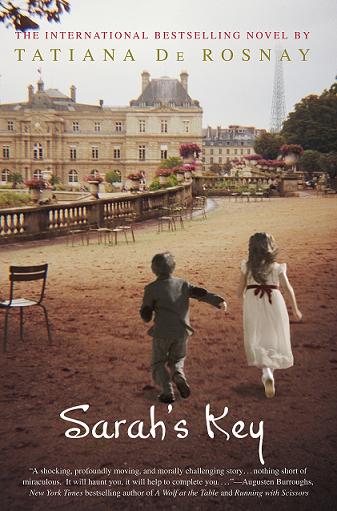
Book Review: SARAH'S KEY by Tatiana de Rosnay

Contemporary/Historical Fiction
St. Martin’s Press, 2007
320 pages  $13.95

On the nights of July 16 and 17, 1942, French police rounded up over 12,000 Jewish citizens and brought them to the Vélodrome d’Hiver, an indoor stadium not far from the Eiffel Tower in Paris. After a few days, these Parisians—over four thousand of them children under the age of 13—were deported to holding camps outside the city. From there, parents and children were separated, shipped to Auschwitz, and killed in the gas chambers.

This incident is known as La Grande Rafle (“The Great Raid”) du Vél d’Hiv. It is one of several wartime incidents that brought such shame to Frenchmen that it was not openly acknowledged for 50 years. Finally, President Jacques Chirac admitted to the responsibility of the Vichy government in a commemorative speech in 1995.*

These events form the backdrop of Tatiana de Rosnay’s startling novel Sarah's Key. Ten-year-old Sarah is arrested by French police on July 16; but before she is taken, she hides her younger brother in a secret cupboard, promising she will come back for him. Her story is juxtaposed with that of Julia, a modern-day American journalist investigating the Vél d’Hiv atrocities as her marriage to a Parisian begins to crumble.

With two such riveting stories—Sarah’s race to save her brother and Julia’s obsession to uncover her story—it is hard to find fault. This is a book that can be swallowed nearly whole. De Rosnay creates engaging characters, even if they seem a bit stereotypical. (The charming yet philandering French husband and the grouchy but good-hearted managing editor come to mind.) Complex, guilt-wracked Edouard, who was a boy in 1942 Paris, is endearing, and Sarah’s grit comes across as genuine, not some Anne Frank-wannabe. The novel’s problems lie mostly in its prose; de Rosnay has a better gift for plot than for the turn of a phrase. The Holocaust is such well-trod ground that, shockingly, we all know what to expect, even if the events are all new to the characters themselves. It requires a deft writer to avoid stereotypes and melodrama, and de Rosnay sometimes comes up short.

On the other hand, the Vél d’Hiv story is largely unknown, which makes this novel relevant even now. The author gives the facts as they happened, inserting her characters into the action, and our hearts race along with theirs. It is a story to cry over, an unbelievable chapter in our collective humanity’s history. Strange that it has become fodder for fiction, for entertainment. But we come to the end of Sarah’s long journey not exactly entertained, but brought up short, astounded and horrified once again. Why dredge up these darkest moments in our past? It is because the darkness lingers still among us, in Bosnia, in Rwanda, in Darfur. We cannot afford to forget.

*With thanks to JewishGen.org for historical information on the incidents at Vélodrome d’Hiver.


Sunday, October 2, 2011

Review: LIFE OF PI by Yann Martel

Contemporary fiction
Harcourt Brace, 2001
326 pages  $16.00 

Sixteen-year-old Pi Patel, son of a zookeeper, is a boy of faith. He has embraced three religions—Catholicism, Islam, and Hindu—to the bewilderment of his secular family. The early part of his story concerns his search for faith; the latter part concerns a test of that faith.

When political upheaval urges Pi’s father to move the family from their native India to Canada, the story reaches its heart—and ours. The family’s shipboard passage is initially a sort of Noah’s ark adventure as the Patels transport their zoo animals to North America. But the adventure becomes desperate when Pi finds himself the sole human survivor in a lifeboat he shares with a Bengal tiger.

Here the Noah parallels end. While Martel suffuses the book with humor and wild, magical touches, this is no Disney tale of a boy and his tiger becoming best friends. Instead he explores how two species learn to survive together despite the fact that one is predator and the other, potential prey.

The book’s structure seems to allow for few surprises. Pi survives; this we know from the start. Though told in Pi’s “voice,” the book is based on a journalist’s interview of the adult Pi, years after the shipwreck. Yet like all great stories, the tension comes in the telling, not in the outcome. You’ll know what I mean if you’ve ever watched Hitchcock’s Rear Window for the fifth time and still can’t help hiding your eyes. It is in the how of the survival that keeps us riveted: How will Pi feed himself? How will he feed the Bengal tiger without becoming the main course? How long will they be at sea, and will either suffer some grave and irrevocable damage? And, as the story becomes ever stranger and unbelievable, we begin to wonder: What’s really up with Pi?

Some reviewers have compared Martel’s book to Hemingway’s Old Man and the Sea—the same singular purpose, the same lonely pursuit of the goal, the ever-present sea always the enemy. But in fact, Martel’s book is not only longer, it’s much more compelling. Hemingway presumed a fascination with his topic that the reader may not share; Martel grabs his readers by the lapels and compels them to look at and live this fascinating story. We can’t tear ourselves away from resourceful Pi, who, though faithful, is never passive. Instead he becomes the protector, even the god, of the small world within his control. Thus a religious sensibility never overwhelms the story, but rather breathes as the fabric and weave of every word.

This is a story to read and savor. It’s that rare sort of book that you race through to find out what happens, only to be disappointed that you’ve run out of pages. When I had nearly finished reading my library copy, I was sorely tempted to buy the book just to have it on my shelf as a kind of constant friend. I settled for buying it as a gift for someone else.