In case you all haven't noticed, Debbie Ridpath Ohi is hilarious and wickedly talented. The illustrator of I'm Bored (written by Michael Ian Black; Simon & Schuster Books for Young Readers, 2012) and the cool new Judy Blume covers, Ohi also maintains a fantastic website here. Here, reprinted with her permission, is one of her classic strips, Will Write for Chocolate.
Used with permission from Debbie Ridpath Ohi at Inkygirl.com under the provisions outlined here.
NOTE: I don't post to this blog super-duper often anymore, because I'm busy writing, well, books. (Read more about that here.) For more up-to-date, day-to-day ramblings, visit my Facebook page.
Showing posts with label punctuation. Show all posts
Friday, May 9, 2014
Friday, April 11, 2014
Fun Friday: Who Gives a #^(! About an Oxford Comma?
I'm a fan of the Oxford comma, people, and not just because it's named after the Oxford University Press, which makes it sound like a supersmart thing. It's come from years of editing using the style book most favored by American publishers, The Chicago Manual of Style. But its use is--gasp--optional. Here's today's informative video on the topic:
And here's today's irreverent take on the topic. (Caution: an R-rated word is featured. You've been warned.)
Friday, August 2, 2013
Hyphen Redux
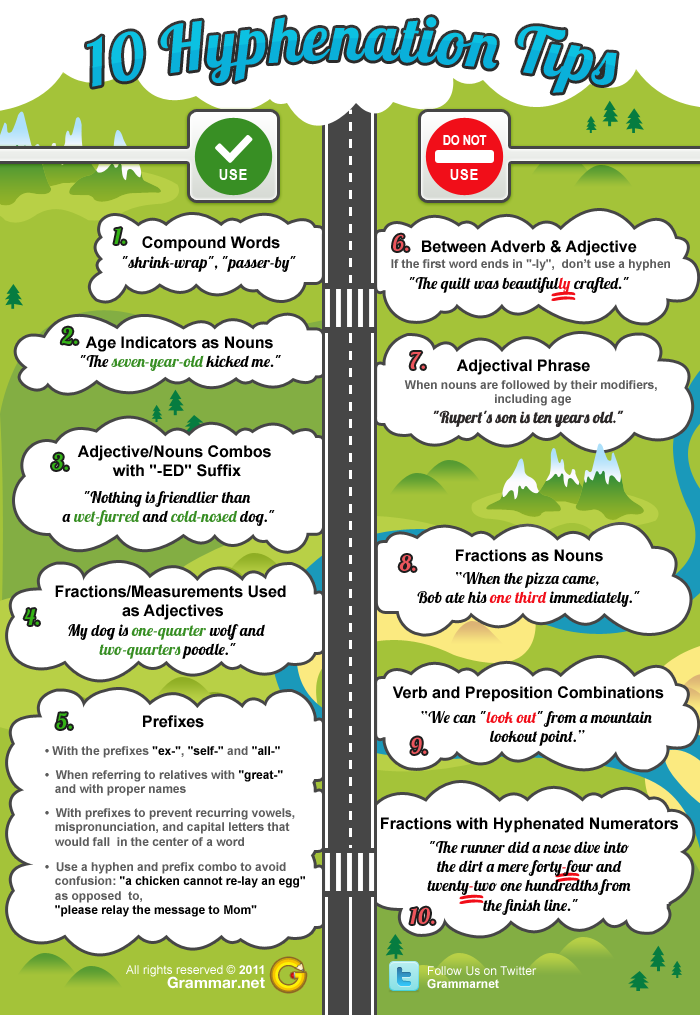
I just found this handy infographic poster for those who are still scratching their heads on the use of the hyphen. It comes courtesy of Grammar.net, which specifically invites folks to embed it on their own sites. So, yeah. I'm not stealing it.

[Infographic provided by Grammar.net]

[Infographic provided by Grammar.net]
Tuesday, July 9, 2013
Pet Peeve: Adverbs and Hyphens
It's come to my peevish attention that hyphens are fast becoming the new scare quotes. In other words, people are suddenly confused about where hyphens are needed, and in a panic, they're inserting them all over the place. But here's a place where you don't need them:
between
an -ly adverb and the word it modifies
First of
all, a refresher course: An adverb is a word that modifies (i.e., describes) a
verb or adjective. Adverbs often (but NOT always) end in -ly:
perfectly
nastily
swimmingly
knowingly
Now, no
one seems to want to stick in a hyphen when these adverbs modify verbs, as in:
Dumbledore winked slyly.Hermione calmly stowed her wand and climbed on Buckbeak's back.Filch smiled nastily.
But for
some reason, when the adverbs modify adjectives, hyphens are applied
willy-nilly. There's no need. So:
The Triwizard Tournament includes three extremely dangerous tasks. (NOT: extremely-dangerous)Ron had a perfectly good reason for avoiding the Forbidden Forest. (NOT: perfectly-good)"Thanks for helping us fight those Death Eaters," said Harry to Neville. "That's awfully decent of you." (NOT: awfully-decent)"A poorly brewed potion will earn you a failing grade," Snape said. (NOT: poorly-brewed)
The
confusion may have arisen because according to the venerable Chicago Manual of Style, adverbs that DON'T end in -ly (and thus,
may be mistaken for some other kind of word) do take a hyphen:
"I must admit, Potter, that's a well-cast spell," said Professor Flitwick.
Because
this isn't a grammar blog (anymore), I won't go into all the ins and outs of adverbs and
adjectives, but you may certainly surf on over to The Grammar Girl for more info. It won't
bother me one bit.
Back to
your studies now. You never know when a pop quiz may be in the offing.
Hyphen update: More, and perhaps clearer, info on the use of the hyphen is in this nifty infographic.
Subscribe to:
Posts (Atom)